Wednesday, 7 May 2014

Kimono and Craft May Meeting 2014


This month  Katie Chaplin introduced us to the art of Kimono dressing. She explained about the fabric of each layer of the outfit and some of the ritual and story behind the item as she dressed her mannequin.
Katie dressing the mannequin in the under kimono over the cotton underwear slip
 
The kimono being held out so we could admire the hand painted and embroidered silk


Katie adjusting the fit of the kimono with a tie
A sash is fixed around the middle to be tied at the back


The sash is tied at the back in a special way over a little pillow
The fully dressed mannequin apart from the socks and shoes
Katie informed us that in Japan it takes about four hours for a woman to be dressed properly in a kimono! It looked beautiful but very few of us would want to spend that kind of time getting ready.


After lunch we started the craft part of the workshop where we each chose two fat quarters of Japanese fabric to make a small folded hand stitched Japanese bag. The fabrics we chose from were beautiful many printed with flowers and gold.


By the end of the afternoon most of us were finishing off the bag by threading the draw string and adding the beads.
We all felt pleased wth our hana bags as we took them home and a big thank you to Katie for telling us a bit more about Japanese culture.
A completed Japanese folded bag with drawstring

Wednesday, 2 April 2014

The Harris Museum, Preston, April Meeting 2014


This month we had an excursion to the Harris Museum to see the Textile collection and learn how it is conserved and stored.
The Museum is a very impressive building with a Greek revival facade and a fine interior.
Harris Museum
We started off by looking at a variety of textiles in small groups each of which was led by a volunteer who explained:
  •  how special coathangers are made to protect the garments from chafing.
  • how samplers, many made my children, are mounted on card and then stored in acid free acetate pockets.
  • how items are cleaned with soft brushes and occasionally a small hoover through netting so as not to damage the threads and then stored in acid free tissue.

  • how lace is stored and identified.
  • how they involved the museum in a joint patchwork venture with the people of Preston.
Our members looking at items in storage and how they are protected from light, fingers, incorrect storage/hanging, insect damage etc.


 After a very pleasant lunch in the museum cafe we were given a tour of the textile gallery by the curator.
A selection of the fashion plates

1950's dresses
Horrock's dresses, with sample books, which were made in Preston
Back and front of a C19 dress
Various dresses with one taken apart to show how it had been made
Various accessories
Goldwork badges and insignia
It was a very interesting day and we learned a lot about what goes on behind the scenes in a museum to preserve textiles for the interest and enjoyment of future generations.
A thank you to Sandra W. for arranging the day.

Wednesday, 5 March 2014

Calico Gardens March Meeting 2014

This month Gillian Darrington inspired us with her beautiful calico gardens. [see pictures below]

It was suggested that we started with a focal point for our picture. This could be a window, door, tree, style or gate.


 Gillian suggested we sewed our focal point  first and then start to build up the picture around the focal point with embroidery stitches or padded work representing flowers , shrubs, stones, rocks or masonry. The threads used would be neutral to light brown and all shades in between.
We were shown how to make stones or bricks with cardboard, pelmet vilene or stuffing material or pieces of tights.


We all made a good start on our calico garden taking them home to finish.
One of our members tried something slightly different and used a piece of printed material not calico and produced a very pleasing result. [see below]
It was a very enjoyable day and our thanks go to Gillian for leading the workshop.

Tuesday, 4 February 2014

Blackwork February Meeting 2014


This month we tried our hands at blackwork with the guidance of one of our members Dorothy Pearce. She gave us a short history of its popularity in Tudor Times and showed us some samples found in paintings of the period.
Blackwork samples from paintings of the C16
  Dorothy had brought a range of beautiful fragile looking pieces for us to see.


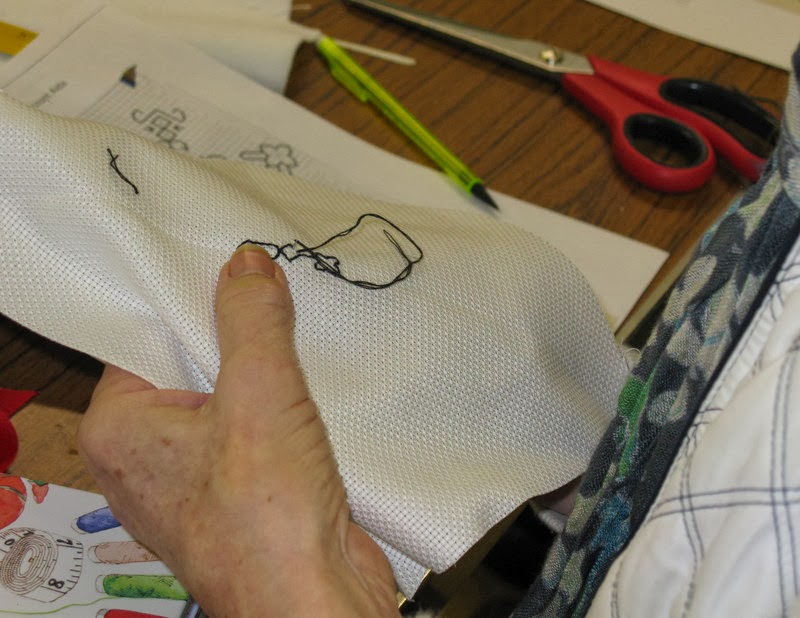
Dorothy had devised a slightly simpler piece for us so that we would not be overwhelmed! She showed us how to start and then we were each given a grid to follow. 


There was absolute silence as we set about counting our squares and following the grid. Some of us found it difficult to start with and there was a bit of unpicking but as we got used to the pattern it became embedded in our heads. Dorothy was on hand with loads of patience to sort out any problems.

 A few of us managed to complete part of the pattern using coloured thread and gold. We were pleased with our results particularly those members who had never tried blackwork before. All thanks must go to Dorothy for being so patient with us and showing us what to do.